Building a production agent harness around Claude Code
What it actually takes to turn Claude Code into a multi-agent pipeline that watches Slack, opens MRs, self-heals CI, and improves its own code — a six-layer production harness.
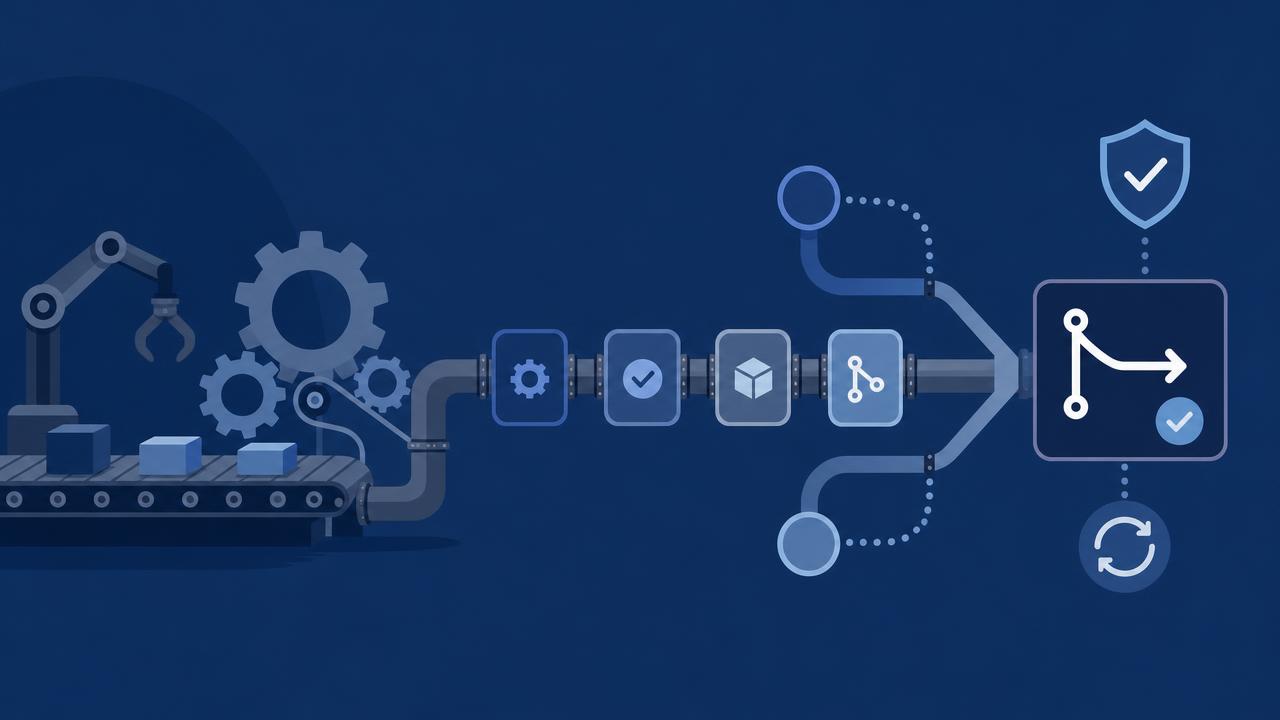
// key takeaways
- ›A bare LLM is a brain in a jar — the harness is the scaffold that gives it senses, hands, and memory.
- ›Three gaps close the distance to production: reactivity, persistence, and quality.
- ›A structured output contract (not free prose) is the single biggest leverage point for keeping LLM output usable in a pipeline.
- ›Confidence must be a gated, mechanically-capped number — not a self-reported score.
- ›Self-improvement that modifies the harness's own code, human-reviewed, is what makes it production-grade.
On this page
- The short answer
- Why a harness, not just an agent
- The six layers
- 1. Event ingestion
- 2. Agent orchestration
- 3. Persistent state
- 4. Self-healing loops
- 5. Observability
- 6. Human-in-the-loop control
- The single biggest leverage point: structured output
- Quality gates: making confidence mean something
- Adversarial review: the red team inside
- Self-improvement: the harness fixes itself
- Takeaway
The short answer
A coding agent on its own is a brain in a jar. It can think and write code, but it can't answer your Slack DM at 3am, retry a failing CI job, or remember that a reviewer's question is still unanswered. The harness — the runtime scaffold around the LLM — is what gives it senses, hands, and memory.
This is a top-down view of one team's production multi-agent pipeline built on Claude Code: one that's watched a Slack channel, opened MRs against five internal repos, addressed reviewer comments overnight, and quietly self-healed CI for several months. The brain (the model) is essentially interchangeable; what changes is the harness around it.
Why a harness, not just an agent
Three failure modes appear within the first week of wiring a chat UI in front of an LLM:
- It loses context when you close the tab. A real task spans days. No single LLM call holds that state.
- It can't react to external change. A reviewer comments at 4pm; CI fails on the third commit. The agent must wake up on events, not poll forever.
- It can't recover from its own failures. It pushes a commit, CI breaks, and the operator has to re-explain tomorrow.
The harness closes three corresponding gaps: reactivity, persistence, and quality.
The six layers
1. Event ingestion
The harness wakes up on external signals — Slack mentions, GitLab MR/CI events, PagerDuty pages — funneled into a unified dispatch queue. The LLM never polls; it gets called. The practical details matter: freeze cursors on empty Slack polls to avoid skipping occasions of consistency lag, dedupe by message tsc past, and pair Socket Mode with a poller as a safety net so connection drops don't swallow messages.
2. Agent orchestration
Workers spawn as transient units carrying a JSON payload naming a workflow + case directory + thread context. Each pipeline is a long-running Claude Code invocation with a curated prompt and a writeable scratch space. The choreography uses several specialized agents chained at defined hand-off points: an investigation agent, a long-lived follow-up agent, a consolidator, and a "doer" that makes the change, watches CI, and addresses review comments.
Two non-obvious choices: everything runs in git worktrees (concurrent cases never step on each other), and the case directory is the single source of truth to which every workflow resolves.
3. Persistent state
State lives in three layers: in-memory caches (rebuildable), local JSON maps (restart-safe), and git-synced workspaces (durable, cross-machine). State lives in git, not in a process — that's how a session resumes on a laptop or a remote VM with full context.
4. Self-healing loops
Three loops close without operator intervention: CI auto-fix (capped at 3 consecutive failures, then escalate), reviewer auto-reply (author-aware dedup so it doesn't re-fire), and an MFA-gated token refresh. Without retry budgets and self-recognition, loops spiral — one flaky test once produced 80 no-op commits in an afternoon.
5. Observability
Four surfaces: live Slack status updates (editing a single message), structured logs to grep, Slack DMs for terminal events (MR opened/merged, escalation), and a system log. Deliberately no dashboard — Slack and grep are the consoles. MCP health gets its own watchdog so an expired token surfaces as "tool returned empty result" instead of "the agent is stupid today."
6. Human-in-the-loop control
All operator interaction flows through a single self-DM with six command families (task, on-call, MR control, pause, finalize, registry). The pause kill switch is calibrated precisely: it silences automatic dispatch driven by other people's activity, but never the operator's own commands.
The single biggest leverage point: structured output
The team's own conclusion: free-form prose is the enemy of a pipeline. Every investigation iteration ends with a parseable JSON contract — completion_report — with status, confidence, open questions, unchecked sources, contradictions, assumptions, and a draft response. The gates evaluate the parsed JSON as deterministic Python, not prose.
Quality gates: making confidence mean something
Confidence would be marketing noise if the model could just write 95 without backing it up. The harness enforces a 19-function gate framework with three families:
- G-gates (logical consistency) — reasoning can't contradict itself across rounds; an increase in open questions invalidates a confidence rise.
- N-gates (structural completeness) — artifacts must be fully formed; every fix pairs with a verify action.
- A-gates (assertion ceilings) — mechanical limits the model can't override through prose. Confidence is arithmetically capped:
1.0 − (open_questions × 0.08) − (unchecked_sources × 0.05), no matter what the model writes.
Gate violations become guard notes prepended to the next iteration's prompt — the forcing mechanism. Gate violations don't block the model; they make the model's previous violations the first thing it reads next round.
Adversarial review: the red team inside
Once the investigation declares itself done with confidence ≥ 70, control passes to a separate Claude invocation playing adversarial reviewer. It evaluates 15 dimensions and produces a verdict — critical issues send the loop back; two consecutive minor-only passes or a clean pass completes it. The same model playing a different role catches a meaningful fraction of self-flattery that single-prompt iteration misses. A structurally separate red-team reviewer sees only the problem statement and final conclusion, checking whether the conclusion was reachable without the investigation's framing.
Self-improvement: the harness fixes itself
The distinguishing feature: the harness's substrate is its own source code, and each closed case feeds back.
- Per-case repair — a gap analyzer identifies where the harness underperformed and opens one PR against the harness's own codebase. Human merge, no human write.
- Cross-case reinforcement — failure modes are counted per project; a weekly cron suggests SOP changes when a mode crosses thresholds. Deliberately not auto-applied, because automated decisions that compound mistakes are a known failure class.
After 20–30 cases, each project's SOP is personalized to its own failure patterns. The harness dogfoods this on itself: pr-ci-fixer picks up failures on the harness's own improvement MRs, so the agent keeps its own CI green.
Takeaway
The load-bearing lesson is the meta-loop: every scar was caught because a real ticket exercised it. The build loop and operate loop are the same loop at different timescales.
> Build the loop first. Make it autonomous second. An autonomous system without a feedback path into its own substrate is just a faster way to ship the same set of mistakes, at scale.
This is an architecture write-up of a practitioner's production system built on Claude Code. Concepts and quotes reference the original essay by Messi Li (May 2026); the mechanism design here is original synthesis. No affiliation with Anthropic.
// related
Harness engineering: what actually makes Claude Code work
Claude Code's success isn't better prompts — it's the harness around the model: a streaming agent loop, a typed tool registry, and a context management layer. Here's the reproducible thesis.

Loop engineering: designing agents that iterate, verify, and remember
A Claude loop is a repeatable workflow around the model — trigger, context, action, verification, state, and decision. Here's how to build one that's safe, stateful, and worth scheduling.
DeepSeek Harness vs Claude Code: the real advantage is replaceable parts
DeepSeek Harness is a developer-preview coding agent whose model, tools, sandbox, and loop are plugins. That makes it a useful experiment—not yet a drop-in Claude Code replacement.